
Posts

The Cultural & Social Impact of Inclusive CSR Practices Across Diverse Global Communities

Corporate Social Responsibility (CSR) has changed dramatically over the years, especially during the global pandemic. What was once often treated as a marketing exercise or philanthropic add-on has become a critical part of how organisations operate, lead, and engage with society. Throughout my career, I have always focused on advocating for CSR practices that are not only responsible but also inclusive and culturally aware.

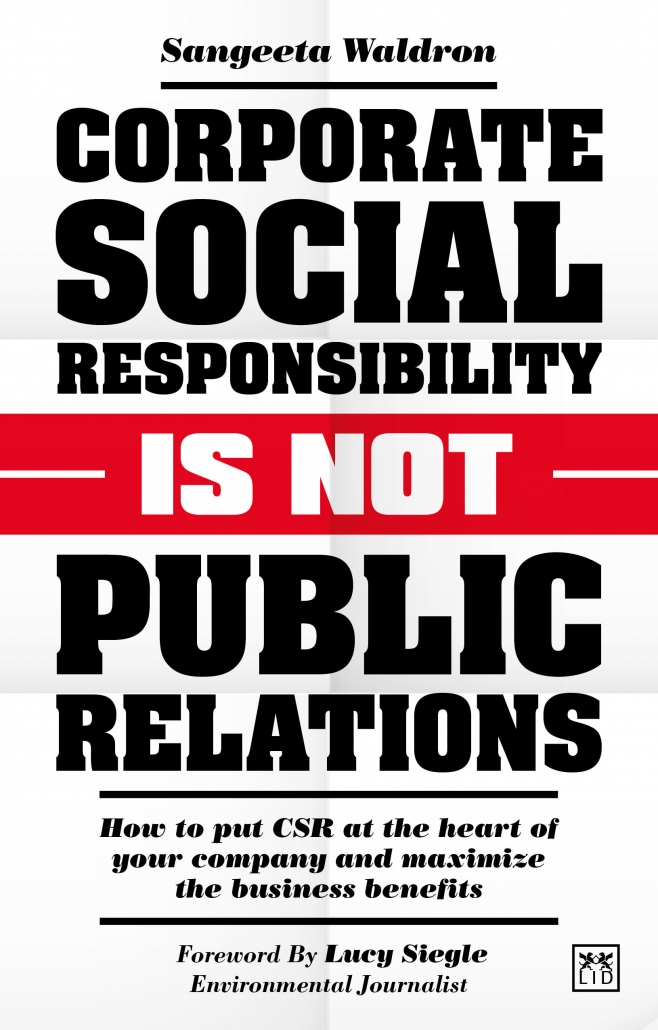
In my book, CSR Is Not PR, I explore the importance of moving beyond performative corporate messaging and towards genuine responsibility. Businesses today operate across borders, cultures, and communities, and because of this, CSR needs to be rooted in authenticity, cultural understanding, and a real commitment to social impact.

Why Inclusive CSR Matters

One of the key themes in my work is the importance of inclusivity in CSR. When companies expand internationally, they often encounter communities with very different social structures, cultural traditions, and priorities. A one-size-fits-all CSR strategy rarely works.

Organisations need to take the time to understand the communities they are operating in, which means listening to local voices, engaging with community leaders, and recognising the diversity within those communities. Inclusive CSR is about ensuring that initiatives are relevant, respectful, and genuinely beneficial for both parties.

When businesses involve local stakeholders in shaping their initiatives, they build trust and create programmes that are far more impactful and sustainable.

The Role of Cultural Intelligence in CSR

It is also important for companies to develop greater cultural intelligence in their CSR strategies. Cultural awareness is not simply about avoiding mistakes; it is about recognising the richness and diversity of the societies they are interacting with and considering the cultural context of their actions. CSR programmes should reflect local values and social realities rather than imposing external frameworks that may not resonate with communities.

In CSR Is Not PR, I discuss how meaningful CSR requires businesses to move away from superficial branding exercises and instead embed responsibility into the heart of their brand and corporate culture. When companies genuinely understand the local areas in which they operate, their initiatives become far more powerful and effective.

Creating Meaningful Global Impact

CSR has always been about long-term impact. Responsible businesses have the potential to support communities, contribute to social progress, and address global challenges. But this only happens when CSR is approached with authentic commitment.

Over the years, I have worked with organisations to help them think more strategically about their social impact. This includes encouraging transparency, accountability, and sustained engagement with communities rather than short-term campaigns designed primarily for visibility. True CSR requires businesses to ask deeper questions about their role in society and how they can contribute positively to the world around them.

Looking Ahead

As global challenges continue to evolve, the need for responsible corporate leadership has never been greater. I firmly believe that businesses can be powerful forces for good when they embrace inclusive and culturally informed CSR practices.

My work continues to focus on helping organisations understand that responsibility is not simply about reputation. As I explain in CSR Is Not PR, CSR should be embedded in how a company thinks, operates, and engages with the world.

When businesses commit to authenticity, respect cultural diversity, and genuinely collaborate with communities, CSR becomes more than a strategy; it becomes a pathway to lasting social impact.

The New Wuthering Heights Film Got Me Thinking

The new Wuthering Heights film got me thinking. Directed by Emerald Fennell, it is presented as a bold reinterpretation of Emily Brontë’s novel. But in Fennell’s version, Heathcliff, one of the main characters, has his identity changed. He is now white, played by Jacob Elordi.

In the 1847 novel, Brontë describes Heathcliff as a “dark-skinned gypsy” and even as a “Lascar,” a term used for South Asian sailors at that time. Both descriptions suggest he is a person of colour. That detail is not incidental; it is central to the novel’s themes of class, race, and social exclusion. Heathcliff is not simply an outsider because he is poor or orphaned; he is racialised as different. It shapes how he is treated, how he sees himself, and why his relationship with Catherine is so fraught. Catherine is white and socially ambitious; in that period of British society, relationships that crossed race and class boundaries were not simply frowned upon, they were virtually impossible. The latest series of Bridgerton explores the power of class well.

Yes, I understand the concept of artistic licence. Stories are retold. Perspectives shift. But we are living in sensitive and polarised times. ‘Othering’ is not abstract; it is real and persistent. Ethnic diversity remains a significant challenge, particularly in the media and communications industry, where representation often fails to reflect the wider workforce, and where senior leadership remains disproportionately white and privileged.

There is also a strong intersection between ethnicity and class, something Brontë instinctively understood. Research by Creative Access and FleishmanHillard UK in 2024 found that 73 percent of working-class respondents in the creative sector feel there is a lack of senior representation. Among Black and Asian respondents, that figure rises to over 80 percent. That is not a marginal issue; it points to a structural imbalance.

When we remove race from a story that is explicitly shaped by it, we are not being neutral. We are making a choice. And that choice has cultural weight.

Embracing ethnic diversity is not simply a moral gesture; it is a strategic and commercial necessity. Diverse teams are more innovative, more productive, and better able to connect with broader audiences. In a global digital economy where culture travels instantly and scrutiny is constant, authenticity matters more than ever.

We must also challenge deficit narratives. The subtle framing that suggests people from ethnic minority or working-class backgrounds are somehow less complex, less universal, or less commercially viable. This type of thinking seeps into casting decisions, commissioning choices, and leadership pipelines.

We need to stop “whitewashing” stories that were never white to begin with. We need different voices around the creative table and not as a tick-box exercise, but as genuine contributors with the power to influence decisions. Because I suspect that if Fennell’s team had been more socioeconomically and ethnically diverse, someone would have paused and asked a simple but important question: What does it mean to erase the very difference that drives this story? Reinterpretation should deepen meaning, not dilute it.

Photocredit: Wikipedia

Behind The Scenes When PM Blair Spoke To The WI

File:Tony Blair (2010).jpg - Wikimedia Commons

A Guardian article published on 30 December brought the moment straight back to me, when, as Head of PR for the WI, I helped advise No.10 on the themes for Tony Blair’s WI speech. This story has been resurrected via files released at the UK’s National Archives in December 2025, and since then it has had a bit of public discourse, particularly from those connected to the story, taking trips down memory lane. To help join the dots, my last name was ‘Haindl’ at that time.

When the Chairman, General Secretary, Head of Public Affairs and I met, No. 10, we grounded our recommendations in what WI members genuinely cared about – sustainability, the countryside, and Fairtrade. All areas where the organisation had long-standing credibility and lived experience. We could see where the risks were and said so. But we were ignored.

What happened became a lesson in leadership communications for Number 10, with the main takeaway being learning to listen to the people who know the audience.

What isn’t really reflected in the article is what happened afterwards…

After the speech, things moved very quickly. Because No.10 had invited the media in such numbers, the story travelled far beyond the room and the WI, unexpectedly, was at the centre of it. Overnight, I went from advising quietly in the background to helping steady the narrative on live programmes and newsroom panels, even finding myself on the front page of the Evening Standard.

What I remember most is not the headlines, but the feeling of having to steady things for members and colleagues while the news cycle accelerated around us. Interviews, phone calls, camera crews, all while making sure the WI’s voice stayed calm, grounded and authentic.

It was one of the first times I saw up close how fast a moment can become a narrative. It was intense (there were some very funny and bizarre moments too) and a reminder that when events escalate, calm communication and clarity of purpose really matter.

Photo credit: Wikimedia Commons


Why Local News Still Matters More Than Ever


Local newspapers are something we often take for granted, yet they play a crucial and increasingly irreplaceable role in the life of a community. They foster cohesion, provide essential local information, hold local government accountable, and support local economies. More than that, they help build a shared narrative of place, offer a platform for diverse local voices, and encourage deeper civic engagement by keeping residents informed about the issues, stories, and decisions that shape everyday life.

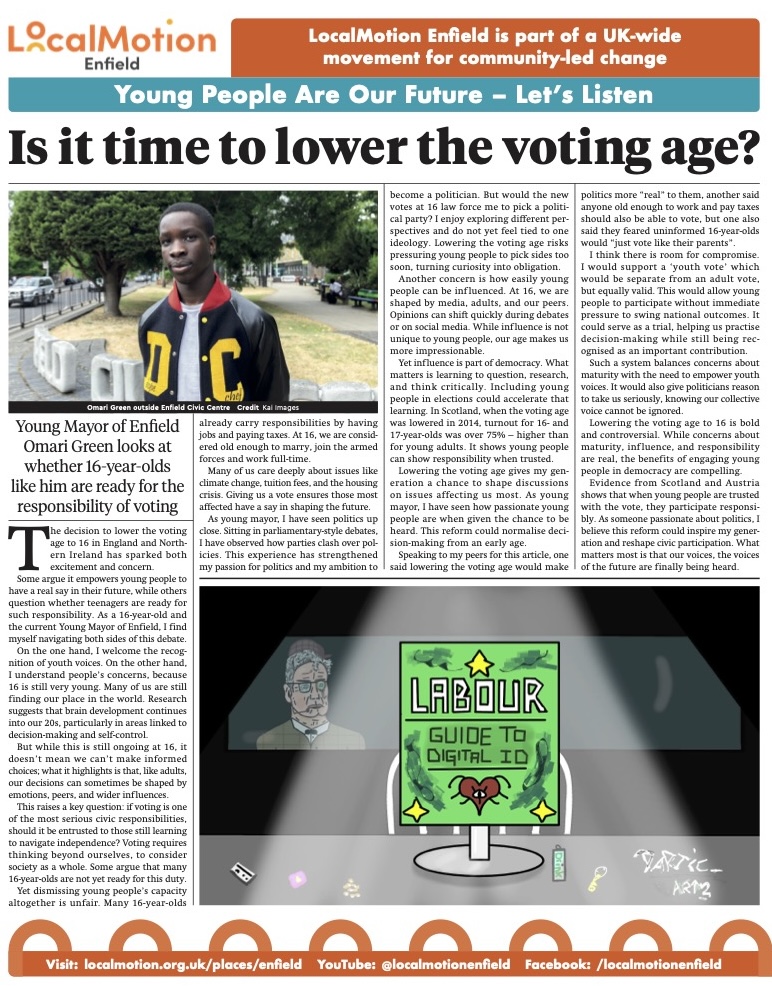
This is why, for the last two years, we have been working closely with our local newspaper, the Enfield Dispatch, alongside the grassroots organisation LocalMotion Enfield, to help connect the many different communities across the borough. Our shared goal is to shine a spotlight on the positive stories unfolding around us. Stories of individuals, initiatives, creativity, and resilience that help local people feel proud of their area and of the neighbours they share it with. At a time when divisive narratives can so easily dominate national discourse, celebrating local connection has never been more important.

During this partnership, our presence in the newspaper has grown from one page to two. The second page is dedicated specifically to young voices and youth action, ensuring that young people are not only represented but truly heard. We have also welcomed a resident political cartoonist whose illustrations comment on local and national social and political issues with sharp humour and insight. Additionally, we now host a regular column written by people living with disabilities, providing a vital space for perspectives that are too often overlooked in mainstream media. Together, these pages aim to be inclusive, empowering, and rooted in authentic storytelling that strengthens community identity.

Insights repeatedly show that audiences place a higher level of trust in local news sources than in national media. This trust stems partly from familiarity, where readers often recognise the journalists, understand the context, and see their own lived experiences reflected. Local outlets can offer nuance, explanation, and relevance that national coverage simply cannot replicate. This makes it far more difficult for misinformation to take root. A thriving local news ecosystem is, in many ways, the first line of defence against disinformation, helping to build an informed citizenry that is less susceptible to manipulation and more willing to participate in civic life.

Sadly, the ongoing decline of the local news industry, driven largely by financial pressures, threatens all these benefits. This is why, here in Enfield, we are committed to making the most of our trusted and much-loved community newspaper.

OmTalks: Legacy And The Wild with Sangeeta Waldron & Melvyn Carlile

On 17 June, I will be in conversation with the very brilliant Melvyn Carlile.

Mel is a visionary founder and the pioneering force behind the Mind Body, Spirit Festival, London. His work has helped to shape the modern holistic movement.

I could not be more excited about this event for many personal reasons. As a young girl of about 7, I used to be my mum’s plus one to the Mind Body Spirit Festival in London, held those days at Olympia. Never did I imagine that one day, I would be in conversation with the founder of this Festival about my book.

Life has just given me lemonade!

Tickets are only £4.50 and to book, click here

The Stakes Are High – Why We Need To Invest In Local Media & Journalism

The stakes are high. The future of news reporting will not only shape our communities and conversations but also influence the very fabric of our democracies. The stories we tell, and the collaborations we forge during challenging times, will be key. At the heart of this is the next generation—how we can support them in better understanding where the world is headed and how they can make a difference. This is why my work with LocalMotion Enfield, a grassroots movement dedicated to empowering communities across our borough, is so crucial.
LocalMotion Enfield operates in a variety of ways, including a media partnership with our local newspaper, The Enfield Dispatch. This collaboration raises awareness of local projects, issues, and community initiatives.
But it doesn’t stop there. Our work is forward-thinking and dynamic, giving young voices a platform and nurturing the next generation of journalists. By doing so, we’re helping combat misinformation and ensuring that these future storytellers are equipped to share the truth.

Asian Achievers Awards 2024

On 27 September, the 22nd Asian Achievers Awards took place at a glittering ceremony in London. The Awards brought together over 500 distinguished guests from around the world to celebrate the outstanding contributions of leading South Asians in the UK. Hosted by former Eastenders star Nitin Ganatra OBE and ITV newsreader Anila Dhami, the evening was a celebration of the exceptional achievements within the British Asian community.

Prime Minister Sir Keir Starmer said: “British Asians are a driving force behind much of the social, cultural, and economic innovation we see in Britain today. You represent so many of the values that help our communities thrive — ambition, hard work, and inclusivity, to name just a few. This is why it is wonderful to see so many British Asian change-makers being recognised tonight by the team at EPG.”

Among the winners were Leicester City footballer Hamza Choudhury, GP specialising in women’s health Dr. Nighat Arif, the founder of the Indian street food chain Chaiiwalas, and the founder of the largest distributor of car parts in Europe Sukhpal Singh Ahluwalia. Former Member of Parliament Virendra Sharma was recognised for his over 50 years in public service and given the Lifetime Achievement Award.

I had my own Oscar moment and had the honour of announcing the winner of the Arts and Culture, which went to the fusion sound duo, Abi Sampa and Rushil Ranjan.

The evening saw electric performances from British Asian music pioneer Juggy D and Edinburgh Fringe Festival winner, stand-up comedian Ahir Shah.


The Traitors Is Fashion Styling For The Sustainable Fashion Faithful


Full disclosure, I have not seen any of the latest season of The Traitors on the BBC, but I have been reading all the articles across the mainstream media about the success of the style success of Claudia Winkleman, the presenter of the show, which has been thoughtfully put together by her stylist Sinead McKeefry. There are so many news pieces, features, blogs, articles dedicated to showing us how to recreate these looks and I am not writing this as a fashion writer, but from the place of sustainability and purpose; and so far, I have seen nothing on this topic.

For those who don’t know, The Traitors is a reality show, which has upped the fashion stakes and caught the attention of the country. It’s a haute country look that has been inspired by the wonderful backdrop of the imposing Scottish castle and landscape setting. It is what I would describe as appropriate winter wear, and what we should all be wearing in the depths of winter to keep us properly warm, none of this acrylic and polyester stuff. The style is woolen cable knit jumpers, sturdy tweed, thick socks with the occasional sweeping theatrical moments.

The wardrobe of the latest season of The Traitors is not about fast fashion. Instead, it will be one that will be brought out every winter, it’s a look that is classic, where the fabric will get better as the years go on and if you look after the pieces well, they will serve you. These are sumptuous knits that will need to be darned with love when holes appear, boots that will need resoling when worn and lovingly polished. This is a style to keep you warm in winter, and in my view what purposeful and ethical fashion looks like, where you invest in this look not just for a season but for the future. This is not a look that should end up in landfill.

It struck me, that the other angle to this clever Traitors look is that it is also about heritage styling and heritage brands, which is wrongly associated with luxury. Especially, as traditionally, prominent heritage companies started as clothing suppliers for blue-collar workers…think of the history of denim or the Doc Marten boots that Claudia Winkleman wears, which are as I have read her favourite boots. Heritage brands have endured the test of time, often with a rugged aesthetic. These are clothes and accessories crafted to do a job, created to serve, and function. Where everything is durable, that can be worn while out and about, and on repeat. The complete opposite of fast throwaway fashion. This is a look for people who know how they want to look, come across, and are confident in their style.

This type of styling is something that British heritage brands do so well and are known for their craftsmanship. As an aside, I think The Traitors will be a boost for British fashion.

So, how am I going to end this piece, well I would love to see more popular programmes, films, and even TV adverts with clever stylists and styling, showing us how to invest in pieces that are meant to be loved forever, not a season. Fashion that is for the ‘faithful’, where pieces become our trusted friends, items that we turn to in winter, summer, spring, and autumn, and is not about dopamine buying.


Photo credit: The BBC

CSR Is Not PR At The PR Link Building Show Brighton


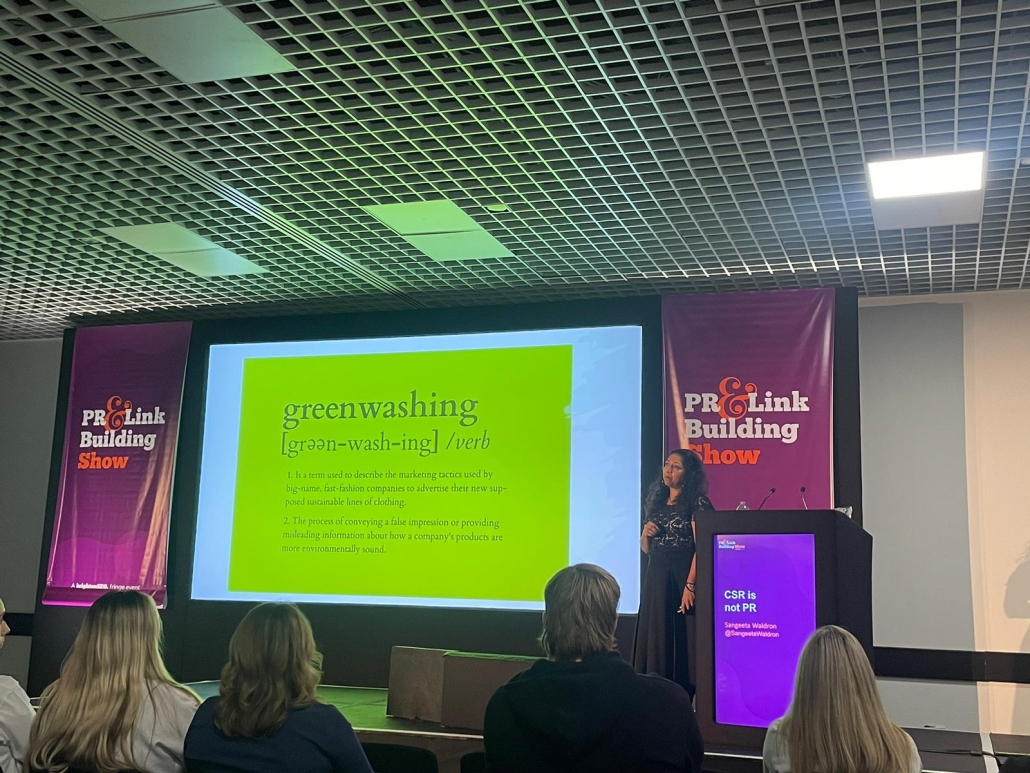
Last week on 13 September I was at the Brighton SEO conference, the largest PR industry show that ran from 13 to 15 th. I was delighted to speak to my industry about how Corporate Social Responsibility (CSR) is shaping PR campaigns, forcing brands to take a long hard look at themselves and their purpose.

And I am pleased to say that CSR Is Not PR was well received by the PR community. Sir David Attenborough has called the plight of the planet a communications issue and yes it does start with us in the media industry…we can help brands be more accountable, to do better, and be authentic about their values and storytelling. There is no room for any business or brand to be making up fairytales, as that’s just greenwashing. Consumers are savvy and voting with wallets, loyal to brands and businesses that are eco-friendly, ethical, and doing right by the environment. After all, there is no business without the planet.

Newspaper Front Page Stories, October 2022 With Links To The Climate Crisis


In light of COP27 happening this week, this photo above is striking and shows the newspaper front page stories in October 2022 with links to climate change and climate risks, from the Media and Climate Observatory (MECCO) Monthly Summaries. The work of MECCO is to monitor media coverage of themes associated with climate change and global warming, as there are no comparable monitoring services for news coverage of climate change or global warming.

MECCO reports that October media coverage of climate change or global warming in newspapers around the globe dipped five percent from September 2022 and 37 percent from September 2021 levels. MECCO’s analysis also shows that coverage in international wire services decreased 15 percent, as radio coverage rose 21 percent from September 2022. Compared to the previous month, coverage decreased in the European Union (EU) (-4%), Asia (-6%), Oceania (-6%), the Middle East (-7%) and North America (-11%).

What is apparent from this data, is that when it comes to news about this topic, media outlets often struggle to gain audience attention. The climate crisis story can seem intractable, depressing, and often difficult to understand. It is also frequently politicised, with audiences polarised on the topic.

However, the following data from MECCO is insightful, showing coverage was up from the previous month in Africa (+14%), and Latin America (+19%), revealing that interest in climate change news is highest in these regions, and this is probably because the countries here have witnessed extreme weather events linked to the climate crisis. Where Chile continues to suffer from severe drought, which has made climate change ‘easy to see’, while this year every part of the African continent was affected by extreme weather events, ranging from wildfires in Algeria to catastrophic flooding in South Africa. It may be that audiences are more interested in news about the topic when they are not so polarised and can clearly see the negative effects of extreme weather where they live.

This data clearly shows that while the climate crisis is one of the biggest challenges for humanity right now, it is not always front-page news. Audiences appear to be more interested in and pay more attention to climate change news in places where the negative effects are felt more acutely. But it is too late if audiences only pay attention once disasters have already struck!

The challenge is how newsrooms continue to cover the issue in a way that draws attention to the causes and decisions that lead to disasters, not just the disasters themselves.

Are there other ways journalists can take to make climate change stories feel more relevant? Perhaps environmental documentaries are the way forward, which have wide appeal and provide clear and engaging stories. Afterall, we are the ‘age of the visual’, with video becoming increasing popular on social media. These visual narratives help audiences connect with what is a very large and sometimes abstract story – while not necessarily being ‘political’. A good example of this is the BBC’s very successful Blue Planet series with Sir David Attenborough and according to the Sunday Times, so many Chinese viewers downloaded Blue Planet II “that it temporarily slowed down the country’s internet”.

As a public relations professional, who knows only too well about the power of storytelling, I believe it all comes down to this…there is always room for better storytelling about the climate crisis.