
Posts

The Trust Files #1: Why Trust Is the Most Valuable Currency in Business Today

When I worked in the UK government writing ministerial briefings and speeches, every statement and every piece of data had to be verified. Nothing went unchecked. Everyone took responsibility for the information they provided by signing it off, creating a clear chain of accountability.

It wasn’t always the quickest process, and it was long before the convenience of email and instant messaging. But there was a respect for accuracy, attention to detail and the truth.

That experience has stayed with me throughout my career.

Today, when I work with organisations, I occasionally see leaders trying to cut corners. Often it’s done with the best intentions: to move faster, meet deadlines or reduce costs. But shortcuts create opportunities for misinformation, inconsistency and mistakes. Over time, they erode something far more valuable than efficiency: trust.

Trust is one of the greatest assets a business can have. It attracts talented people, strengthens customer loyalty, builds confidence with partners and investors, and protects an organisation’s reputation when challenges arise. It isn’t a communications campaign or a marketing slogan; it’s a business strategy.

I explore this in my book Corporate Social Responsibility Is Not Public Relations; trust cannot be manufactured. It is earned through consistent actions, transparent communication, and leaders who do what they say they will do.

The good news is that building trust doesn’t have to be complicated or expensive. It requires commitment, clear processes and a culture where accountability is everyone’s responsibility. That means putting frameworks in place, encouraging openness and ensuring that people across the organisation understand not only what the business stands for, but how those values are reflected in everyday decisions.

One area that is often overlooked is internal communication. Organisations spend significant time and money communicating with customers yet forget that trust begins with their own people. Employees who understand the organisation’s purpose, values and direction become its most credible ambassadors. Without that internal foundation, external messaging can quickly lose its authenticity.

Trust isn’t built by one department or one leader. It is created collectively, through thousands of decisions and interactions every day.

Because in business today, trust isn’t just a nice-to-have. It is your most valuable currency.

The Trust Files is a monthly series exploring the role of trust in leadership, communications, reputation, and business.

If someone experienced your organisation today, as a customer, employee or partner, what would make them trust you?

The Trust Files: Why am I writing The Trust Files?


Over the past three decades, I’ve worked across government, global organisations, the private sector and purpose-led businesses. One lesson has remained constant: organisations succeed or fail on trust.

Trust influences reputation, attracts talent, strengthens customer relationships, reassures investors and gives leaders credibility. Yet, despite its importance, it is often treated as something intangible, something that belongs to communications rather than business strategy.

I don’t believe that’s true.

Through The Trust Files, I’ll be exploring how trust is built, how it can be lost and, most importantly, what leaders and organisations can do to earn it every day. Drawing on my own experience, current events and examples from around the world, this series will look beyond headlines to examine why trust has become one of the most valuable assets any organisation can possess.

Because trust isn’t built overnight. It’s earned through the decisions we make, the stories we tell and the actions we take.

Coming next: The Trust Files #1: Why Trust Is the Most Valuable Currency in Business Today.

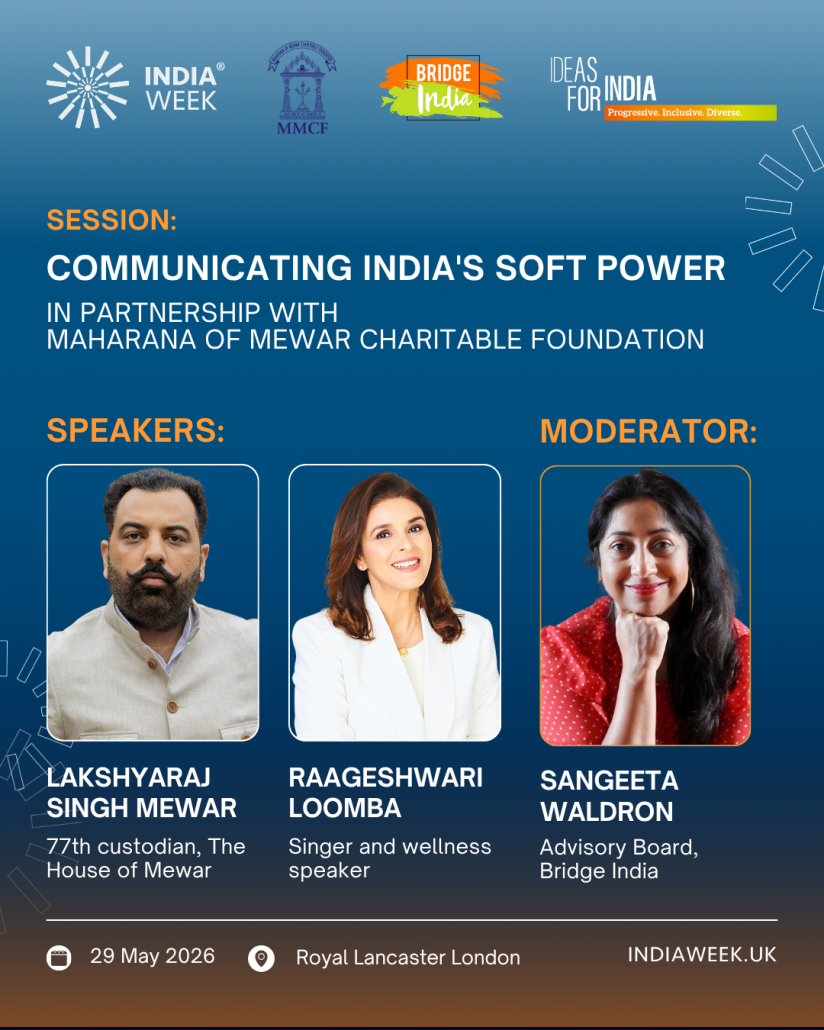
Communicating India’s Soft Power, 29 May, London


India has long been one of the world’s greatest cultural influencers, though much of that influence often goes unrecognised! From yoga and spirituality to spices, architecture, paisley print, film, and music, India’s impact on global culture is everywhere.

Remember last year’s “Kolhapuri-gate” when Prada featured the traditional handcrafted Kolhapuri sandal on the runway without acknowledging its Indian roots or the artisans behind it.

So when the organisers behind Ideas for India invited me to moderate a session on Communicating India’s Soft Power, I jumped at the chance.

I’ll be joined by two brilliant minds:

Lakshyaraj Singh Mewar : philanthropist, global ambassador, and businessman, carrying forward one of India’s most storied royal legacies. 77th Custodian of the House of Mewar.

Raageshwari Loomba, award-winning singer with platinum records across pop music and Bollywood, now also a mindfulness author and speaker.

Together, we’ll explore how India can tell its own story to the world, not just through economics and politics, but through culture, creativity, heritage, and values.

India’s soft power has never been lacking…what’s been missing is recognition, ownership, and stronger storytelling. And on that, did you know that Tina Charles’ career was launched by Indian music producer, Biddhu…?!

Book here for Ideas for India


Insights on Trusting Instincts and Building Resilient Businesses Amid Crises

Over the years, one of the most important lessons I’ve learned as an entrepreneur is the power of trusting your instincts. In business, we often talk about strategy, data, and planning, and of course, those things matter, but instinct plays an equally vital role in leadership and decision-making.

When I founded my business, I didn’t have a perfect roadmap, and the world was in the midst of the 2008 global recession. However, what I did have was a strong sense of purpose and an ability to listen carefully to people, to opportunities, and to that internal voice that tells you when something feelsright. That instinct has guided many of my decisions, particularly during moments of uncertainty.

Crises have a way of testing every aspect of a business. Economic downturns, shifting markets, and the global pandemic challenged organisations everywhere. For me, these periods reinforced the importance of adaptability, resilience, and calm leadership. Rather than reacting with fear, I focused on clarity and solutions, asking what our clients needed most and how we could continue to deliver meaningful value. During the pandemic, I was working with the Indian and Bangladeshi curry houses across the UK, as the hospitality industry was hit the hardest. We used this time and instincts to pivot and focus on public affairs, lobbying thegovernment on what support the sector needed.

Trusting my instincts didn’t mean ignoring strategy; it meant combining intuition with experience. Years of working with organisations, understanding communication, and navigating complex situations have helped shape my judgement. Sometimes the best decisions came from listening carefully, reading the moment, and having the courage to act decisively. I have found that trusting your instincts makes you braver and bolder.

Building a resilient business is not about avoiding challenges; it’s about learning how to move through them with confidence and integrity. For me, instinctual leadership has been a guiding force, helping transform uncertainty into opportunity and ensuring that even in difficult times, the business continues to grow and thrive.


Behind The Scenes When PM Blair Spoke To The WI

File:Tony Blair (2010).jpg - Wikimedia Commons

A Guardian article published on 30 December brought the moment straight back to me, when, as Head of PR for the WI, I helped advise No.10 on the themes for Tony Blair’s WI speech. This story has been resurrected via files released at the UK’s National Archives in December 2025, and since then it has had a bit of public discourse, particularly from those connected to the story, taking trips down memory lane. To help join the dots, my last name was ‘Haindl’ at that time.

When the Chairman, General Secretary, Head of Public Affairs and I met, No. 10, we grounded our recommendations in what WI members genuinely cared about – sustainability, the countryside, and Fairtrade. All areas where the organisation had long-standing credibility and lived experience. We could see where the risks were and said so. But we were ignored.

What happened became a lesson in leadership communications for Number 10, with the main takeaway being learning to listen to the people who know the audience.

What isn’t really reflected in the article is what happened afterwards…

After the speech, things moved very quickly. Because No.10 had invited the media in such numbers, the story travelled far beyond the room and the WI, unexpectedly, was at the centre of it. Overnight, I went from advising quietly in the background to helping steady the narrative on live programmes and newsroom panels, even finding myself on the front page of the Evening Standard.

What I remember most is not the headlines, but the feeling of having to steady things for members and colleagues while the news cycle accelerated around us. Interviews, phone calls, camera crews, all while making sure the WI’s voice stayed calm, grounded and authentic.

It was one of the first times I saw up close how fast a moment can become a narrative. It was intense (there were some very funny and bizarre moments too) and a reminder that when events escalate, calm communication and clarity of purpose really matter.

Photo credit: Wikimedia Commons


Indian Bestseller Nectar on the Seven Hills by Local Based Author Prabhu Ram to Be Published in the UK

Delighted to be working on this Indian bestseller, Nectar on the Seven Hills, by London-based author Prabhu Ram, To Be Published in the UK. Nectar on the Seven Hills has been compared to Harry Potter.

Apologies…

Apologies the last few months have run away with me and with good reason. I completed the manuscript for the third book I was writing…a book that took me over a year and a half to write. What Will YOUR Legacy Be? – Conversations With Global Game Changers About The Climate Crisis will be out on 30 January 2025. I then returned from Milan in November, where the pro planet film I was representing at FICTS, which is an event for film television and sports – won an award!  FICTS is closely associated with the Olympics. The film project I was part of, cleverly tied water sports with marine conservation, where we combined the power of storytelling with sustainability and sport.
As soon as I was back from Milan, a couple of days later Serendipity PR was at the Business Show, where we also hosted a lunchtime session speaking about why the business community needs to be thinking about its sustainability initiatives. It was busy at the Show and there was a definite buzz. Companies want to do the right thing and be authentically sustainable. There is a real drive to do better.

I have also been working on an initiative looking at the relevance and importance of local newspapers, media, and journalism with City Hall. This is a really interesting project, because those who know me, will know that I believe in the importance of local newspapers, which I regard as the backbone of communities, providing independent information about what is going on in local areas. Sadly, with the advent of social media, we have seen a decline in local newspapers in the UK, even the London Evening Standard now only has an online presence where much of the news is curated by artificial intelligence. There are very few local newspapers with a real editor left, who reports on the ground. I believe we need to recognise local journalism as an important part of community life and invest in this mechanism of information, which counteracts misinformation and disinformation. This will be ongoing work.

As I furiously type to get this posted in time for Christmas, let me say this…2024 has been a year of lots of opportunities, where a variety of seeds have been sown for 2025…where next year will be a flourishing garden of interesting initiatives, announcements, and celebrations. Stay tuned and Merry Christmas!


Working With The Gandhi Foundation

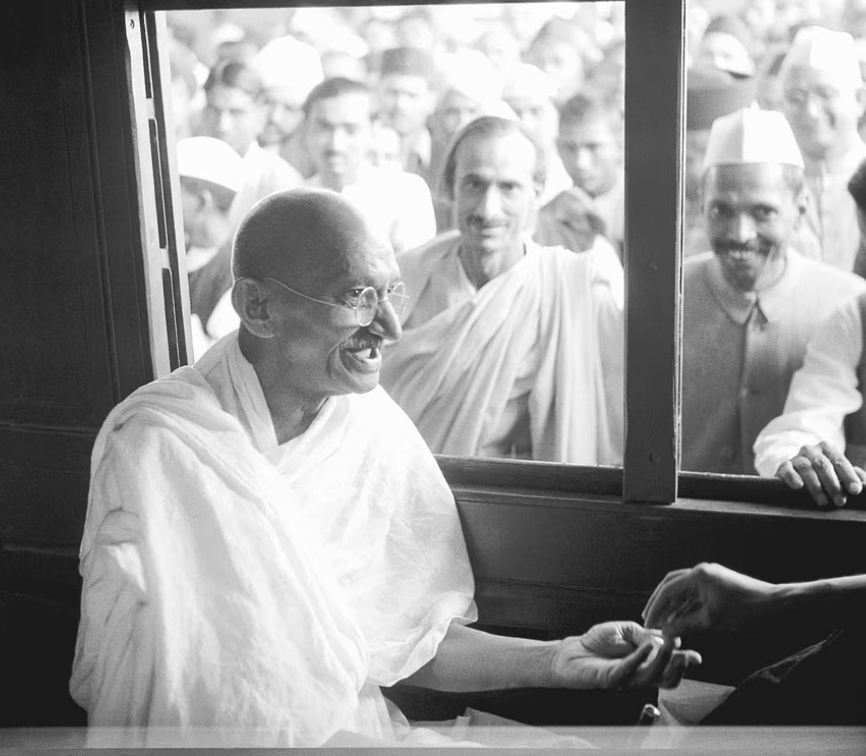
Sometimes your ancestors call out to you and make things happen in your present. This is how this story goes…Late last year I started to explore my family history from my mother’s side, regarded as one of the pioneering Indian families in South Africa. I knew that my great-grandfather worked with Gandhi when he was in South Africa and helped Gandhi establish the South African Indian Congress; and that my grandfather was very active with the Indian Congress too and was instrumental in creating change, bringing sport, particularly football to the Indian community in South Africa.

Anyway, I started to think a lot about my grandfathers and their work with Gandhi, fast-forward to September last year, when I was invited to speak at Threads of Change, organised by Khadi London, at the Nehru Centre. At this event, the chairman of the Gandhi Foundation, Mark Hoda came to speak to me. He said he followed his instincts to talk to me (this is why we should always trust our gut instincts, that inner voice) and well, as they say, the rest is history. I am now very proud to be working with the Foundation.

The principles of Gandhi are so relevant to everything that is taking place today – we need to be the change to tackle climate change; we need tolerance for each other and more than anything we need collective people power for peace, and harmony and to create balance.


Photo Credits: The Gandhi Foundation

Shedding Light on The Challenges Marketing Teams Face On Their Net Zero Journey

I was privileged to be part of a panel discussion with experts on 6 December 2023, where we shed light on the challenges sales & marketing teams in B2B organizations face on their journey to Net Zero – based on the latest business research commissioned by Hattrick in partnership with The Carbon Literacy Trust.

We delved into some of the complexities businesses are navigating and discussed what’s needed for organizations to make genuine progress on their sustainability journey.
Facilitated by Josh Pitman from Priory Direct, the panelists were:
– Phil Korbel, Co-founder/Director of Advocacy at The Carbon Literacy Project
– Sangeeta Waldron, Founder/Owner of Serendipity PR & Media and author of the acclaimed book ‘Corporate Social Responsibility is not Public Relations’
– Christos Tsaprounis FCIPD (he/him), People & Culture Leader, Auto Trader UK
– And Malin Cunningham, Founder/Owner of Hattrick | B Corp™ certified
You can watch here:

Download the report here!

Success At The Business Show This November


It was an incredible full-on two days at the Business Show at the Excel Centre in London on 22 and 23 November. We met lots of people, talked to lots of companies about corporate social responsibility (CSR), talked to many people about the book, CSR Is Not PR, sold lots of copies of the book, and just had a good time.


On the first day of the Show, which was 22 November, we also had an opportunity to create an interactive session about the book, which was very popular, where lots of people had to stand.  I am grateful to Ben Walker, the award-winning business editor, for being such a great host and getting everyone involved. There were some great questions from the audience, with two questions that kept cropping up – what’s the difference between CSR and ESGs (environment, social, and governance); and how do you track CSR?


There was a lot of love for the book, and the two posters proved to be a hit, we had lots of attendees coming over to take photos for that Instagram moment!  My highlights were when someone came rushing over to the stall to buy a copy of the book, because they had seen so many people carrying the book at the Show and had FOMO! The other moment was when the company, Print and Trees arranged to plant a tree in South America to acknowledge the book and support it.

I want to say a few thank yous – to my publisher, LID Business Media, and everyone who swung by our stall at the Business Show. I shall leave you with a few more photos from the event.